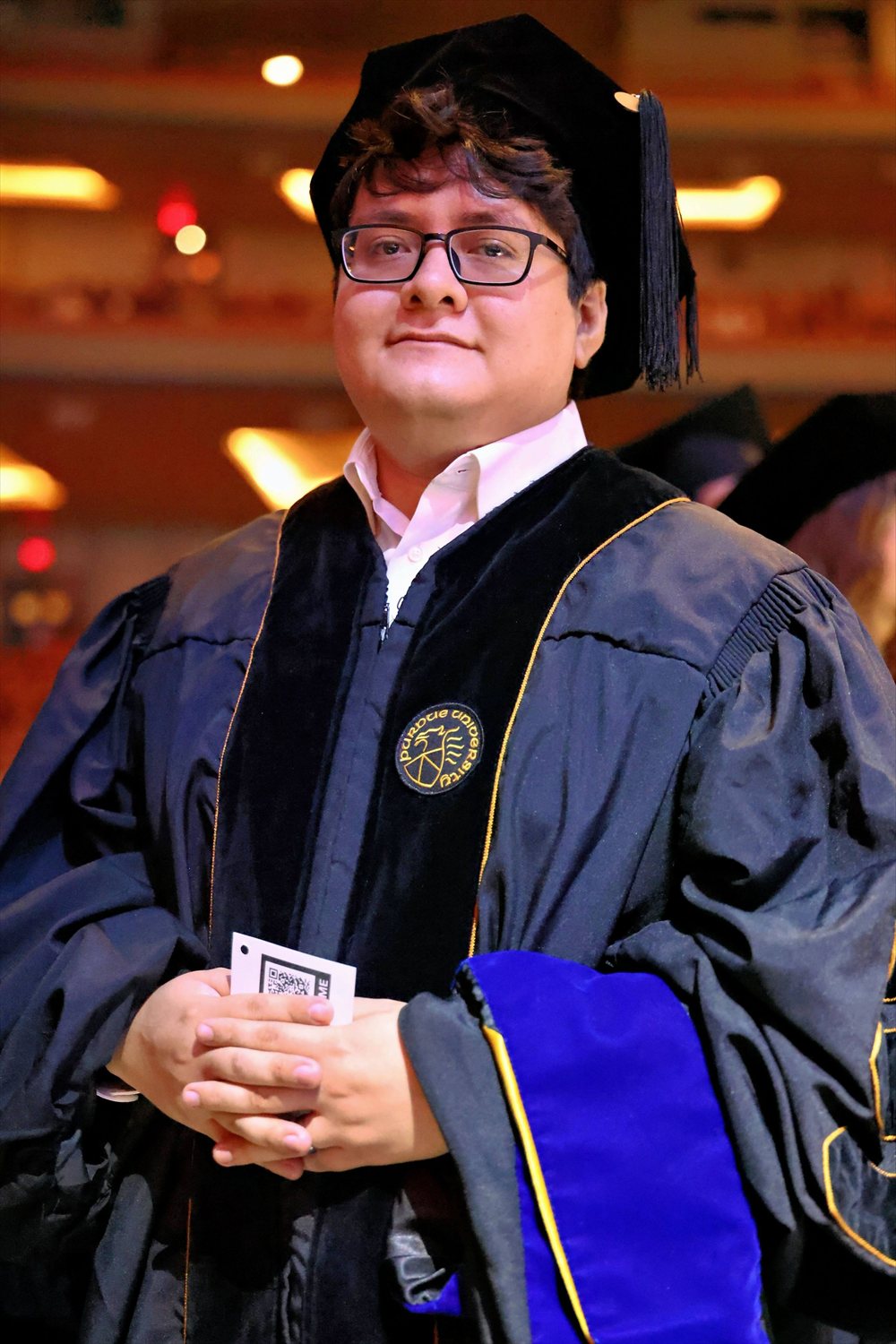
Welcome to my academic webpage, I am a postdoctoral instructor in the Department of Mathematics at Rice University under the mentorship of Anthony Várilly-Alvarado. I recently finished my PhD at Purdue University under the supervision of Trevor Wooley. I study problems concerning Diophantine equations via the Hardy–Littlewood circle method. In particular, I am interested in the statistical properties of rational and integer solutions to polynomial equations.
Research
My research concerns the existence and distribution of integral solutions to systems of polynomial equations. My main tool of choice is the Hardy-Littlewood circle method, which is a powerful tool in analytic number theory which exploits the identity
\[\int_0^1 e^{2 \pi i \alpha n} d\alpha = \begin{cases} 1 & \text{if } n=0, \\ 0 & \text{if } n \in \mathbb{Z} \backslash \{0\}, \end{cases},\]
and allows one to employ the techniques of Fourier analysis to tackle problems in analytic number theory.
Selected publications
Accepted
The Hasse principle for random homogeneous polynomials in thin sets
Joint work with Kiseok Yeon. To appear in Mathematika. We make progress towards a conjecture of Coliot-Thélène, which predicts that the Hasse principle holds for all homogeneous polynomials of degree \(d>3\) in at least \(d+1\) variables. Specifically, we show that if we average over a thin set of polynomials of degree \(d \ge 17\) and at least \(24d +1\) variables, then the Hasse principle holds with probability tending to \(1\) as the size of the thin set tends to infinity.
Published
A circle method approach to \(K\)-multimagic squares
We study the existence of \(K\)-multimagic squares, which are square matrices whose entries are integers and satisfy the condition that if we raise each entry to the \(k\)-th power then the resulting matrix is a magic square for all \(1\le k\le K\). We show that for any \(K\ge 2\), there exist infinitely many \(K\)-multimagic squares of size \(N > 2K(K+1)\).
Journal of the London Mathematical Society 112 (2025), e70290.
Contact
Institution
Department of Mathematics
Rice University
Herman Brown Hall 450